In the recent past, the obsession with land ownership has steadily decreased owing to the availability of more investment options. Rather than buying land and waiting for its appreciation, financial portfolios like stocks and bonds have become popular as people continue to find innovative ways of creating and multiplying wealth.
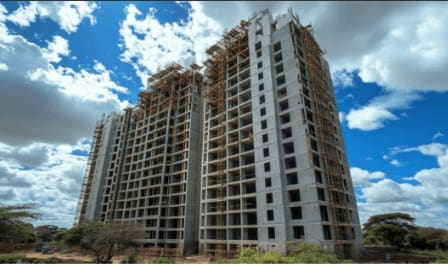
At the same time, most people strive to own a space and become rent-free. Some prefer to own homes in rural areas with abundant space, surrounded by nature, while others prefer to settle near the city and enjoy the fast life. However, the city has limited land, with most residential areas developing apartments.
Land is a fixed resource; it cannot be increased or decreased, making it a scarce commodity. You can only alter the shape, area or elements on the land. With this in mind, we can understand why traditional bungalows spanning large acres of land are starting to take a back seat. Especially in urban areas, developers are economical with land because it is limited, owing to numerous apartments, office complexes, and malls that accommodate thousands of houses and businesses.

In most multilevel establishments, systems have been set up to accommodate the tenants, including having a caretaker, security to guard people's belongings, and even signing in and out as a precautionary measure. But what if someone wanted to own an individual unit in such an establishment?
Sectional Property allows you to own a unit in a multilevel development, including receiving a title deed. This concept is gaining traction because it allows for a building to have various legitimate owners, a brilliant way for people to own homes and offices in a convenient location. Initially, the developer owned the land and building. He/she would form a management company through the Companies Act and 'sell' the units as sub-leases.
The unit members had certificates and shares in the management company, making them 'owners' of the property with a Mother Title for the entire development.
Many issues arose from this arrangement, including the developer retaining the Mother Title and not giving shares to the unit 'owners', leaving him/her with ultimate control over the property. The developer could also refuse to exit the company after selling all the units and charge service fees to the unit members.
Other times, the developer would not include a renewal clause for the unit members since the units were 'sold' as leases under the Mother Title. This arrangement was risky for the unit members because they had no real property ownership.
To achieve Sectional Property ownership, we must describe the development as a 3D space. When we look at it this way, it is easy to see where one person's 'space' ends and another's begins.

In Sectional Property, each member entirely owns their unit while all members jointly own common areas like the garden and driveway. Each member gets a Strata Title as proof of ownership and the Mother Title becomes void.

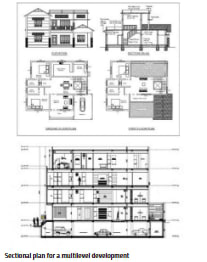
Some of the requirements for Sectional Property include a corporate body, not under the Companies Act, responsible for common areas, a detailed plan of each unit to be submitted as a sectional plan, approved building plans, and a copy of the Mother Title. Sectional Property titles are processed through a Licensed Surveyor.
The legal framework for Sectional Property is outlined in the Sectional Properties Act 2020, which also provides dispute resolution guidelines if any between unit owners. Sectional Property is valid for both leasehold and freehold land.
While some developers prefer to rent apartments and complexes for long-term income, others have embraced the new reality and are developing multilevel establishments purposefully for sale. Sectional Property is most suitable for areas with high demand and limited land.
Despite the relief that Sectional Property gives unit owners, owning property in such an arrangement has its downsides, the main one being the lack of privacy. Even so, the advent of Sectional Property is a solid step towards sustainable land management and maximizing the limited resources we have. Maybe someday, we will slowly relinquish the ingrained concept of soil ownership and embrace space ownership.