
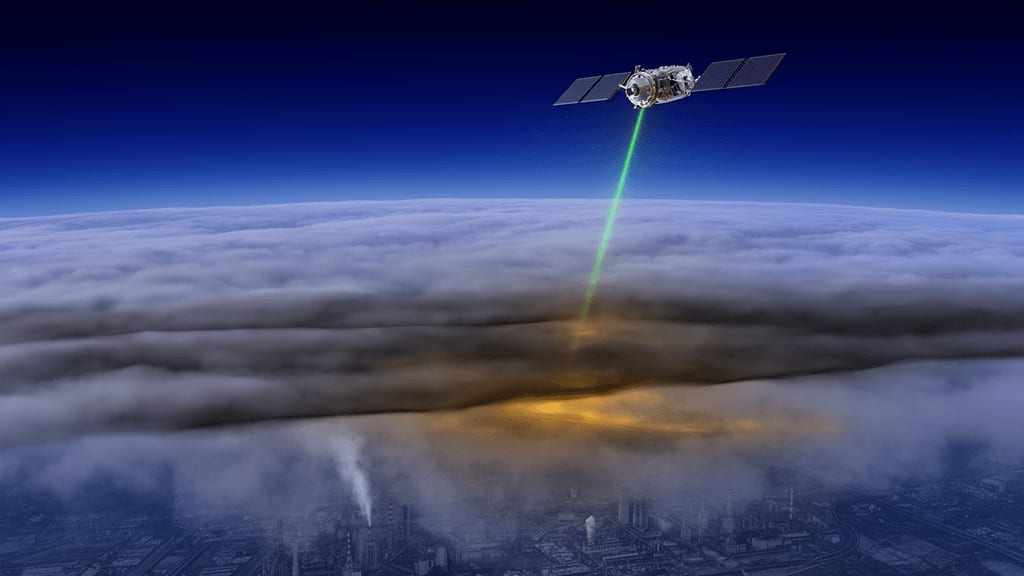
Lidar assimilation exposes lofted black carbon layers over South and East Asia
Researchers led by Yueming Cheng and Tie Dai at the Institute of Atmospheric Physics, Chinese Academy of Sciences, with colleagues in Japan, published a component-resolved aerosol data assimilation system in Atmospheric Chemistry and Physics on 19 October 2026. It builds a local ensemble transform Kalman filter into WRF-Chem and assimilates CALIOP-MODIS retrievals of extinction profiles for dust, sea salt, black carbon and water-soluble aerosols over East Asia (March 2021).
The free-running model badly missed black carbon, with a correlation of 0.10 against CALIOP; assimilation raised it to 0.59. The system recovered an elevated black carbon layer near 6 km, mainly from Indian subcontinent plumes. Against AERONET, aerosol optical thickness bias fell from -0.278 to -0.208, and single scattering albedo improved at 33 of 36 sites. Diagnosed shortwave heating rose by about 0.3 K per day at 4–5 km, with reduced heating below.
Why it matters: Species-resolved vertical constraints from space lidar give modellers a way to correct aerosol absorption and heating, not just total optical depth. The approach could in principle be applied to other regions, including biomass-burning areas, though the study covers only Asia.
Read the full story at Atmospheric Chemistry and Physics (Copernicus Publications / EGU) →