
Google and NASA JPL model finds more methane plumes in EMIT space station data
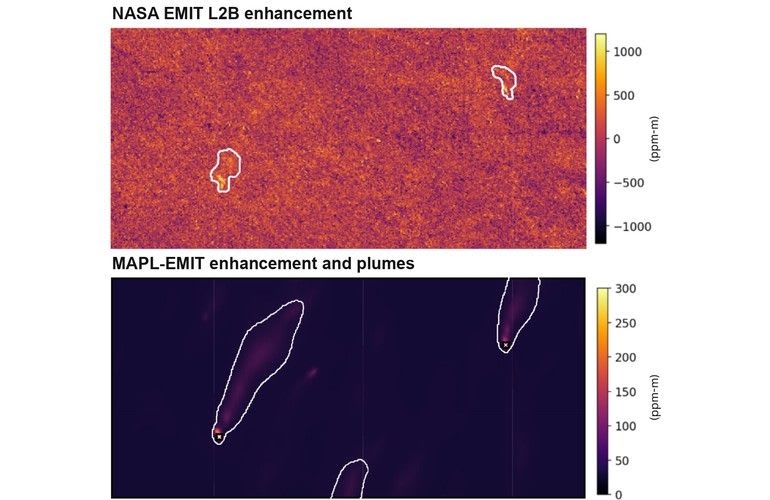
Researchers at Google Research and NASA's Jet Propulsion Laboratory have built MAPL-EMIT, a vision-transformer model that detects methane plumes in radiance data from the EMIT imaging spectrometer on the International Space Station. It was published in PNAS on 1 September 2026.
The model was trained on 3.6 million simulated plumes injected into real EMIT scenes. On 1,084 EMIT granules it captured 84% of hand-annotated NASA plume complexes and found roughly 1.5 times as many plausible plumes as human analysts. It located simulated sources to within about 101 metres on average, separated overlapping plumes, and found plumes at 24 of the 25 top-emitting landfills, against 17 for NASA's product.
The authors say false positives remain a challenge, so some review is still needed. Outputs are released as Earth Engine collections, with the model and synthetic data on Kaggle and code on GitHub.
Why it matters: Open, facility-scale methane plume data from an existing sensor lowers the cost of screening oil, gas, coal and landfill sites. Practitioners can apply it to African landfills and fields, though detections need spectral and wind checks first.
Read the full story at Google Research / NASA JPL (Batchu et al., PNAS) →